Food Science Minor
Overview
Students in this minor gain a comprehensive understanding of food, from production to its impact on human health:
- Food composition and chemistry. How physical and chemical properties of food affect quality, safety, and nutrition.
- Food processing and preservation. Techniques such as fortification, processing, and storage to maintain or improve nutritional value, quality, and safety.
- Human nutrition and physiology. How foods affect metabolism, health, and performance, including athletic performance.
- Food safety and quality control. Ensuring foods are safe, stable, and appealing.
- Dietary strategy and public health. Using nutrition knowledge to improve individual and population health, inform policy, and educate consumers.
- Applied problem solving. Using science-based approaches to solve real-world food system challenges.
Students also develop interdisciplinary critical thinking that connects lab science with human health and food systems.
Experiential Learning
The Food Science minor is intentionally flexible and designed to integrate seamlessly with a wide range of majors, from agricultural and resource economics to nursing, engineering, and other science-based disciplines. Students engage in interdisciplinary coursework spanning animal science, nutritional sciences, food processing, and product development, gaining a broad yet applied understanding of food systems.
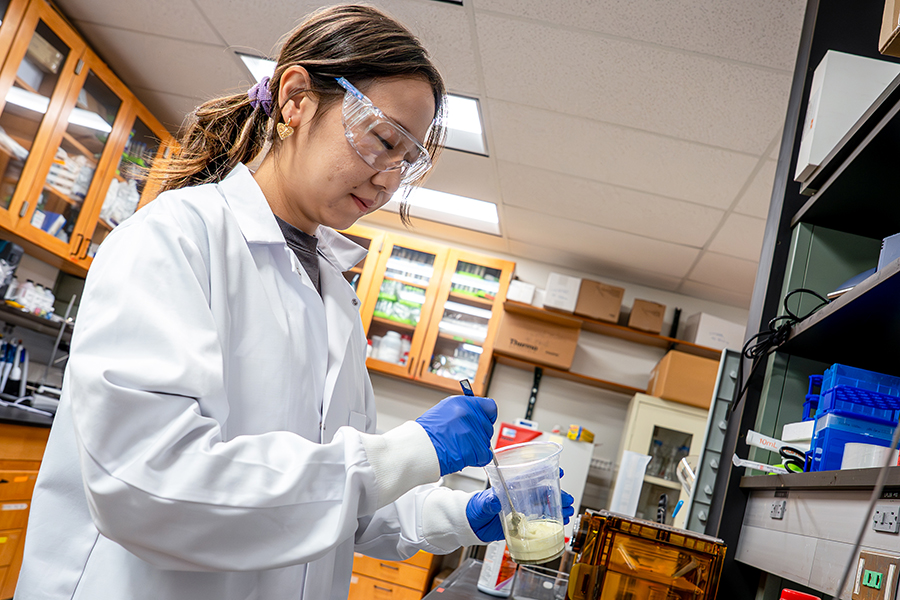
Hands-on learning is central to the experience. Through applied science coursework and laboratory-based instruction, students connect theory to real-world challenges in food production, processing, safety, and nutrition. Many students deepen their experience by participating in faculty-led research in food science or nutrition laboratories, where they build technical skills and contribute to ongoing scientific discovery.
The minor also allows students to tailor their academic focus to align with their professional goals. Areas of emphasis may include:
- Food product development
- Nutrition and health
- Data, statistics, or economics of food systems
Why UConn
This minor is jointly offered by the Department of Animal Science and Department of Nutritional Sciences. Both units provide strong expertise in food chemistry and food systems, nutrition and metabolism, food safety and quality, product development and food processing, human health and dietary science, and applied, industry-relevant research.
Faculty in these departments work at the intersection of food, health, and agriculture, which gives the program both scientific depth and practical relevance.
Career Outcomes
This minor prepares students for careers and further study in areas such as:
Job Roles
Graduates who pair the Food Science minor with their major may pursue specific roles such as:
- Food scientist or Product development specialist
- Quality assurance or Quality control analyst
- Food safety specialist or Regulatory affairs associate
- Nutrition educator or Community health coordinator
- Clinical research assistant
- Public health program coordinator
- Sensory analyst
- Food systems data analyst
- Agricultural or Food policy analyst
- Laboratory technician in food or nutrition sciences
Depending on their primary major and career goals, students may also pursue advanced degrees leading to roles such as Registered Dietitian Nutritionist, Food Microbiologist, Research Scientist, Physician, or Veterinarian.
Industries
Food industry
- Product development
- Quality assurance
- Food safety
- Regulatory affairs
- Processing and manufacturing
Nutrition and health fields
- Dietetics
- Public health
- Wellness and health promotion
- Clinical or community nutrition
Research
- Food science
- Nutrition science
- Agricultural or biological research
Policy and education
- Food policy
- Consumer education
- Public health outreach
Pre-professional pathways
- Medicine, PA, pharmacy
- Veterinary or animal-related health fields
More Information
View the minor’s requirements and plans of studies, or contact the departments for more information.